March 31st, 2012

Use a metaphor as truth

So here I begin, using a simile to introduce a list of aphorisms which are are really metaphors.  But words are a writer’s game, and playing with words can make a great prompt!  (And there’s another metaphor.)

I caught myself listening to myself making conversation the other day and being self-conscious about how often I used metaphors and similes (and loads of the other schemes and tropes of figures of speech:  if you want to entertain yourself further, see http://en.wikipedia.org/wiki/Figure_of_speech ) to get my point across (across what?  the point of a pencil? the tip of my tongue?).

I tried to stop.  I stuttered.  I finally realized it’s just a conversation, silly, just use the rich language of metaphor and keep the ball rolling (a green ball? a basketball?  how big is it?)

You may be getting my drift by now (a snow drift?  sand?  how deep?)

We take these phrases for granted, sprinkle them in our speech and use them wryly (or seriously) in our writing, when we use them at all, since we are good little writers and avoid cliches and overused aphorisms.  Yet all of these came about for good reason: they are used to tap into shared experience and collective imagination to call forth a mood or colorfully describe something, in a far more evocative way than regular old everyday language.

Today I am asking you to take them seriously.  Very seriously.  DO NOT use these as metaphors or similes.  Use them REAL – ly.  What happens to someone if they actually have a bee in their bonnet?  If they actually are between the devil and the deep blue sea?  I append the full list below, but for those of you who prefer a game of chance (literally), print them out and cut them up so you can pull from phrases at random.


So here’s a question: does using a metaphor as truth automatically make it a pun?

Finally, is it weird that many of these would make really good plotpoints in a horror movie screenplay?

 
acid test
ants in his pants
another nail in the coffin
an axe to grind
bee in your bonnet
better the devil you know
to bite the dust
to dice with death
to eat one’s words
to have feet of clay
to put your foot in your mouth
a baptism of fire
blood is thicker than water
open a can of worms
costs an arm and a leg
to keep the wolf from the door
to drink like a fish
not enough room to swing a cat
keep your ear to the ground
to hit the jackpot
you’ll be the death of me
to mend fences
to have a finger in every pie
to give up the ghost
to go on a wild goose chase
to get in each other’s hair
to live in an ivory tower
to keep your head above water
to leave no stone unturned
to go out on a limb
to make a mountain out of a molehill
to cast pearls before swine
to have skeletons in the cupboard
to split hairs
to swallow hook, line and sinker
the writing on the wall
get your ducks in a row
it stinks to high heaven
a frog in the throat
to burst someone’s bubble

You may come out of this exercise with a brand new appreciation of a few tired old phrases!

1
Posted in Deb Auten |
March 28th, 2012

Our pals at Merriam-Webster  have compiled Top Ten Lists. I especially like the list of words for colors and oddball insults. Vocabulary-building made easy.

http://www.merriam-webster.com/top-ten-lists/top-10-rare-and-amusing-insults/mooncalf.html

0
March 25th, 2012

For all our kids’ lit writer pals, here is Publisher’s Weekly take on the week in Italy:

http://www.publishersweekly.com/pw/by-topic/childrens/childrens-industry-news/article/51170–looking-for-the-next-thing–at-bologna-2012.html

0
March 23rd, 2012

Does everybody know about  Wordsmith.org? The word today is

“pug

PRONUNCIATION:

(puhg) 
MEANING:
verb tr.: 1. To knead clay with water.
2. To fill with clay or mortar.
3. To make soundproof by packing with clay, sawdust, or mortar.
4. To track by following footprints.
noun: 5. A footprint, especially of a wild animal; a pugmark.
6. A boxer.
7. A dog of a breed having a snub nose, short hair, wrinkled face, and curled tail.

ETYMOLOGY:

For 1-3: Origin unknown. Earliest documented use: early 1800s.
For 4-5: From Hindi pag (foot, step), from Sanskrit pad (foot). Earliest documented use: 1851.
For 6: Short for pugilist (boxer), from pugnus (fist). Earliest documented use: 1858.
For 7: Of unknown origin. Earliest documented use: 1702.
USAGE:
“For wheel-throwing, once the clay is pugged and wedged, it can be centred on the wheel.”
Edwin Wong; Going Potty Over Handmade Dinnerware; New Straits Times (Kuala Lumpur, Malaysia); Sep 25, 2010.”There is the oddly delicate track of a leopard and the just-plain-scary pugs of a male lion.”
Mike Leggett; Tales of Life in the Wild; Austin American-Statesman (Texas); Aug 12, 2010.

“Sporting comebacks used to be associated with desperate pugs risking their final brain cells for a cheque desperately needed to pay off a bookie or a bar tab.”
Richard Hinds; Thorpe Brave to Meddle With Golden Legacy; The Age (Melbourne, Australia); Feb 5, 2011.”

Who knew?
0
February 29th, 2012

There’s a book I’ve been working on for a long time.  I love this book, yet I struggle with it, particularly in that vast grey middle where the heavy lifting of plot gets done, where I can’t help but think of Douglas Adams’ pithy title The Long Dark Tea-time of the Soul. 

I’ve always known there was a part missing, something crucial.   I could never bring myself to send it out to make the rounds of agents and publishers, not seriously.  I put it in the metaphorical drawer for years, after working on it for years, only bringing it out again a few months ago.  For a time, I hummed along on the sheer joy of recommitment.  I would finish it this time, I’d let my unconscious work on it enough, I’d make the middle sing!

At least, that’s what I thought until I got there, after  a few happy weeks revising the first few chapters   Apparently my unconscious hadn’t figured it out yet.  My muse was giving me the silent treatment.  My other half-finished books began their siren call, work on me instead, bits of plot flotsam for each floating up to capture my imagination.  (The fact that I have all these unfinished books is another blog post.)

I sternly reminded myself that I’d made my usual over-dramatic pronouncement to the writers’ group that this was the book I had to finish before I could write anything else.  The fact that I had to be stern with myself was almost enough by itself to send me running back to my chick-littish LA mystery.  Writing is supposed to be fun, isn’t it?  I’m supposed to love writing!   And here I was, letting my day job get in the way of my writing again!

Maybe it was over-dramatic, but when I said I needed to finish this book, out loud, to a roomful of people I love and respect, I remembered I was saying what I believed, and the saying it out loud was an act of faith.  I do need to finish this book.  And that meant having faith I could shape the dull void in the middle that obscured what was on the other side, not only an ending I love but the rest of the middle.  Is that what I’ve been afraid of?  Is part of the block fearing that I might come up with something that will affect the rest of the book?

Could be.  I’ve always known that there’s a “darling” or two (or three or…) that might have to go.  But here’s the thing:  the last two prompts in group  (see Barbara Mayfields “First Video Writing Prompt” and stay tuned for Susan Rathjen’s upcoming post on her prompt about completely reversing a belief) have let in some light.  I have a brand new proto-scene.  The void is vanishing.  And joy of joys, this scene actually calls back into the manuscript one I’d liked but abandoned long ago (ahh, electronic storage devices) when it was more of a digression than a furthering of the plot.

Faith works.


0
February 22nd, 2012

We all know the advice about writing every day, that consistency is the best way to keep the momentum going. Oliver Stone said it best when asked what it took to write a script. Answer: “Ass meets chair.”

But what if you sit down one day and you just can’t do it? You are mired in your middle or you can’t get to the next plot point without sounding inauthentic. Or you simply don’t have time. These are the situations when our momentum is in danger of breaking.

Here’s a solution someone in my mom’s creative writing group shared: If you can’t/won’t write, sit anyway. Sit and do nothing. Chances are the rest will do you good. It might relax the knot in your scene. Or it might get you antsy to start scribbling.

And if you don’t have time? Take one minute. Everyone has one minute. Sit and do nothing. Nothing is space and creativity grows best where it has room. If someone asks what you are doing there looking idle, you can say, I’m working on my writing!

Calling a little corner of your day your writing time, whether you actually pick up a pen or not, means the structure is always in place for your writing to happen. Oliver Stone was right!


1
February 22nd, 2012

Video Writing Prompt: “OK Go” Rube Goldberg Machine – Amazing

A FaceBook pal turned me on to the OK Go band videos, which seethe with creativity, whimsy and wisdom. Last Friday, we watched this video as our writing prompt.

I find Rube Goldberg machines, especially one as spectacular as this one, inspiring and enchanting. I asked our writing group to write a piece with these thoughts as a jumping off point:

1. Have a seemingly small, innocent action set off a string of oddball, wacky, outrageous results.

2. Whimsy

3. What materials would your character use to create a RG machine?

Happy Ash Wednesday from Barbara Mayfield

0
February 16th, 2012

I’m a bit obsessed with writers and writing process. Well, at least, I thought I was the only one until I went to my first writing conference. Now I know that writers in general, want to know about other writer’s process. We spend an unusual amount of time alone. We need to know what our peeps are doing so we feel normal.

When I meet a writer, I want to know everything. Here are some questions that come to mind. What time of day do you write? How long do you write at a time? Do you write before you get out of bed, or do you need coffee first? Do you have a daily routine, or how do you organize your day? Where do you write? Do you have an office that’s like a cave, or is it filled with light? What’s on your desk that you must have in order to write? Do you write privately, or in coffee shops? Do you write by hand or use a computer? What kind of pen do you use? (I want to say that last one is my favorite question, but they’re all my favorite question.) What weight is your paper? Do you feel guilty that you use so much paper or have you been able to let that one go? Do you have a ritual that gets you started? Do you light a candle, meditate, do a breathing exercise, or stretch?

In my twenties, I thought of writers as having crazy, un-brushable hair, sitting at manual typewriters in a sea of wadded-up papers, chain smoking, and drinking gin, straight. However, at the age I actually started writing, it was more about hand writing everything the first time around, drinking a decaf soy latte plus trying to remember to drink all the water I could possibly stand, and stretching every once-in-a-while. Where did those stereotypes come from?

To feed my obsession, please tell me about your writing process.

2
February 11th, 2012

Imagination is more important than knowledge. Knowledge is

limited. Imagination encircles the world.-Einstein


Perhaps we can encircle our writing today with the idea of love,

specifically, romance versus reality. A few quotes to

guide us:

I was nauseous and tingly all over. I was either in love or I 

had smallpox.-Woody Allen

Love is grand. Divorce is a hundred grand-Anonymous

The trouble with women is that they get all excited over 

nothing-and then marry him.-Cher

I was married by a judge. I should have asked for a jury.

-Groucho Marx.


To love is to suffer. To avoid suffering one must not love. But

then one suffers from not loving. Therefore to love is to suffer,

not to love is to suffer. To suffer is to suffer. To be happy is to love. To be happy then is to suffer. But suffering makes one unhappy. Therefore, to be unhappy one must love,or love to suffer, or suffer from too much happiness. I hopeyou are getting this down.-Woody Allen


Prompt: Write a scene where your character explores romance v

romance vs reality. This can be love of a person, (romantic

or not) an idea, place, thing or situation. For example: we

may be so attached to what we think as love, we miss the

reality. Or vice-versa.


0
February 4th, 2012
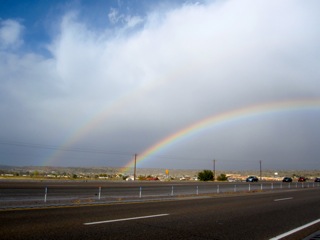
Double rainbow seen on the way to Santa Fe

Double rainbow seen on the way to Santa Fe

I’m posting this article by C. Hope Clark. I subscribe to her newsletter at FundsforWriters.com – and y’all might like it. This particular article has blown off my socks. Thank you, Hope Clark, from Barbara Mayfield.

“WHAT IS YOUR GOAL THIS YEAR?

Nope, this is not another New Year’s resolution piece.
I simply want you to define, in one sentence, what you
hope to accomplish in 2012 . . . with your writing.

Sounds simple, but many writers can’t do this. They
actually fight it. Focusing on writing might mean they’re
accountable, when many writers want the freedom of no
deadlines or parameters. After all, isn’t that the definition
of an artist? Complete freedom of expression?

The problem is, most people cannot function when they have
no limitations. How do they know when to do something?
When is it due, or late, or accomplished? Then others make
lists, spreadsheets and notes on calendars. Benchmarks and
tallies. And that’s as far as they get.

Pick one project that will represent you well in 2012.
Then center your world around it.

Let’s say . . . write a novel.

When you’re enticed to enter a contest, don’t do it, unless
it’s for a novel. When you see a retreat, don’t go, unless
you go to write the novel. When you attend a conference,
only go to further your novel. When you see a Chicken Soup
that catches your fancy, only do it if you’ve already worked
on your novel for the day.

Nothing gets done unless it’s affiliated with the novel.

What if you write magazine articles?

Quit reading about self-publishing. Quit puttering with
short stories. Put aside the poetry. You are a magazine
writer. It’s what you breathe each day. You have magazine
editors on your Twitter account, and scout for them to
mention their needs. You read magazine blogs leaving
comments in hopes of being recognized by the editor.
You pitch to print, online and blog editors, trying to
break in from any angle.

Focus and diligence. We hear it all the time. But all too
often it’s only after we drop in the bed and take note
of our day, that we realize we let it slip by. We didn’t
touch the novel. We didn’t find a new magazine market.

But we’re multifaceted creatures. Fine. Just keep your
priorities. Don’t play and dabble in other writing until
after you’ve worked. Your 2012 project is your job.

Build a fire under your 2012 project. It’s the only
thing on your horizon. It’s difficult, but if practiced,
by the end of the year, you’ve become an expert and
accomplished enough to be proud of.

Define your 2012 goal. Then use it to define yourself.
Hope”

Read newsletter online at: http://www.fundsforwriters.com/FFW.htm

1